http://wingboy8th.blogspot.com/http://wingboy8th.blogspot.com/http://wingboy8th.blogspot.com/http://wingboy8th.blogspot.com/http://wingboy8th.blogspot.com/http://wingboy8th.blogspot.com/http://wingboy8th.blogspot.com/http://wingboy8th.blogspot.com/http://wingboy8th.blogspot.com/http://wingboy8th.blogspot.com/http://wingboy8th.blogspot.com/http://wingboy8th.blogspot.com/http://wingboy8th.blogspot.com/http://wingboy8th.blogspot.com/http://wingboy8th.blogspot.com/http://wingboy8th.blogspot.com/http://wingboy8th.blogspot.com/
I WILL BE POSTING HERE!!!!!!!!
http://wingboy8th.blogspot.com/http://wingboy8th.blogspot.com/http://wingboy8th.blogspot.com/http://wingboy8th.blogspot.com/http://wingboy8th.blogspot.com/http://wingboy8th.blogspot.com/http://wingboy8th.blogspot.com/http://wingboy8th.blogspot.com/\
http://wingboy8th.blogspot.com/
Tuesday, August 25, 2015

Thursday, May 14, 2015
Lone Star by Fehrenbach Reading Assignment #8 (p.g. 640) "Politics in the 20th Century and Joseph Bailey"
Fehrenbach talks about politics in the Early 20th Century in Texas and the United States. A new neo- Populist, Joseph Bailey, was the leader of the House and was forced into retiring from previous affairs.
- Texas was becoming the largest habitually Democratic state.
- The new conservative, Bailey, had many personal affairs, forcing him to retire.
- Texas gained great seniority in Congress
- Joseph Bailey was the minority leader of the house before his elevation to the Senate.
- Bailey's "affairs" became the hallmarks of the Texan neo-Populist in national politics

Friday, May 8, 2015
Lone Star by Fehrenbach Reading Assignment #7 (p.g.414) "The Democratic Political Process"
Fehrenbach talk about the Democratic political process being ignored and how some of the Ex-Confederates felt and how they were being treated after being defeated.

- The real tragedy of the 1869 election was the fact to impose the Carpetbagger rule was perverted and imposed the entire democratic political process.
- Ex-Confederate Generals thought the the Southerners were "a conquered people."
- Americans hoped that the political process would soon be restored.
- Any men who served for the Confederates were denied of service.
- Most of the Democrats avoided to vote during the Hamilton Stuart election because they knew he would loose.
Tuesday, May 5, 2015
Research Pictures on WWI
WWI PIC PP
These are the pictures that I am using for my research project on WWI. I will post pics later on in the month!
These are the pictures that I am using for my research project on WWI. I will post pics later on in the month!
Thursday, April 30, 2015
Lone Star by Fehrenbach Reading Assignment #6 (p.g. 410) "Politics and Black's Right To Vote during Reconstruction"

Fehrenbach writes about how any Confederate that was in office was removed and replaced by a Union soldier or congressman. He also writes about how the some whites supported the blacks to vote and some did not.
- Anyone who worked in office with a Confederate background were dismissed from command.
- All Confederates were replaced with congressmen with a Union background.
- Confederates were prejudiced or hated throughout the Reconstruction period.
- Some whites treated the blacks in a good manor: The Freedmen's Bureau helped the blacks vote and get civil rights.
- Some whites treated the blacks in an evil manor: The Ku Klux Klan appeared in Texas and started to protest against the black's right to vote. They would eventually start lynching amd burning blacks.
Thursday, April 23, 2015
"The Celebrated Jumping Frog of Calaveras County" Questions

- On the fourth paragraph, he said the event happened in '49 or '50. Does this story take place in the 19th or 20th century?
- What is the gender of the narrator?
- What is a "bull pup?"
- Why was Jim Smiley naming different animals that could be in his box when talking to the man?
- What is quail shot?
- Why would Mark Twain write this story?
Monday, March 30, 2015
Lone Star By Fehrenbach Reading Assignment #5 (p.g. 143) "Struggles of Austin's Settlement"

1. The settlement was subject and loyal to Mexico and there rules.
2. The settlement was miles away from the nearest town. The roads were in bad condition and trade between towns was hard.
3. Clothing made in Europe was high in trade value. It traded for items such as hogs and horses.
4. Some exports from Austin's colony were cotton, beef, tallow, pork, lard, mules, ect. Most of these items were transported to the United States.
5. In Austin's colony, there were 443 salves and 1,374
Wednesday, March 25, 2015
Lone Star by Fehrenbach Reading Assignment #4 (pg. 360) "Trade in Texas"

This page talks about trade in Texas, more specifically, trade of material goods. It also talks about the conflict between two groups because of trade.
- Some items that were traded included nails, medicine, Napoleon muskets, Enfilade rifles, Kerr revolvers, black sugar, coffee, wax candles, and a few French gowns.
- People would pay anything for these items, especial people near the Rio Grande.
- A broker who paid $60,000 for their items would usually sell out in a week.
- Hebert, a man already hated because of politics, halted the trade which made lots of people angry.
- When cotton became more popular, more merchants left the business.
Friday, March 13, 2015
Wednesday, March 11, 2015
Lone Star by Fehrenbach Reading Assignment #3 (pg. 509) "Location Based Attitudes & Red VS. Blue"
Some Texans, Mexicans, and Indians acted and lived differently based on their location. For example, Texans that lived near Mexico acted like posh Mexicans. Fehrenbach also talked about the political factions, "Red and Blue." They consisted of people from all around the country.
- Texas historians have come to the conclusion that different races tend to transmit their vices, instead of their virtues, to each other.
- The Mexicans were attracted by Anglo social and political democracy and material success.
- One phenomenon was the birth of genuine machine politics.
- Both leaders of the Reds and Blues were Anglos and members were usually wealthy.
- The Reds included Charles Stillman, who was the son of James Stillman who was a banker.


Excel Slave Population & Total Population of Texas, 1819-1860
This is a clipping from our assignment yesterday. We used excel to make a chart and make an analysis of the population of both slaves and the total.

Lone Star by Fehrenbach Reading Assignment #2 (pg. 205) "Alamo Preparation"
 This page talks about both sides, the Texans and the Mexicans, preparing for the attack by calling reinforcements, organizing guns, and setting out the plans.
- 150 of the Alamo's men were Farmers.
- Even though Bowie thought the Alamo need 1,000 men to protect the Alamo, he never considered giving up.
- Santa Anna was angry of his brother-in-law's loss at Bexar. He was determined to win this battle
- Santa Anna had excellent intelligence supplied by Mexican racheros in the south.
- Every colonist who had taken part in the rebellion against Mexico was to be executed or exiled.
Monday, March 9, 2015
Lone Star by Fehrenbach Reading Assignment #1 (pg. 311) "Ranking in Texas"
 |
| A Dog-Run type House. This is actually the kind of house that is used in the book Old Yeller. |
Here are some Facts/Arguments Frehrenbach states on page 311.
- It was hard to find class conflict in Texas; Might have been because Texas just became a country.
- The aristo-democracy of Texas worked well, because every citizen was, or had the opportunity to be, a freeholder.
- It was, of course, impossible for any Texas white to identify with blacks.
- The life of plantation whites was a different world from the disorder and labor of the average dog-run (cabin w/ and opening in the center)
- Austin's Old Three Hundred embraced settlement in Texas and started building houses.
Friday, February 13, 2015
Equality Essay
Wesley
Dent
Mr.
Horner
February
13, 2015
Literature
The Novel Theme of Equality
The theme of equality appears in
novels and in real life. In books, short stories, and news stories about
different countries in war, equality can be seen and identified. As the Declaration of Independence states, “All
men are created equal.” In some cases, this is false. In the selected novels, Animal Farm, The Crimson Cap, and Harrison Bergeron, one will learn about Animal Farm’s equality failure, The Crimson Cap’s success with equality
in some cultures, and Harrison Bergeron’s
attempt to set up equality.
Equality in Animal
Farm is a major aspect in the story. After the animals take over the farm,
the pigs establish rules for the animals, one of them being, “All animals are equal.”
Throughout the story, the rules fall apart and the pigs start to rule over the
other animals. In the end, all of the rules are removed except for one, which
reads, “All animals are equal, but some animals are more equal than others.”
Napoleon rules the animals and all signs of equality are gone. Orwell is known
to have hated a famous communist named Karl Marx, who wrote about equality in
several documents. Orwell wrote Animal
Farm to show that, in his opinion, communism, an economic system based on equality
of ownership, would fail.
Equality in The Crimson Cap appears where ever the protagonist, Pierre, is
taken. At first, Pierre is with the French. They treat him like a child, do not
give him much respect, make him walk, and blame him for everything. La Salle,
the leader of the expedition, is given a horse to ride, plenty of food to eat,
and clean clothes to wear. While Pierre is with the Indians, he is treated like
everyone else. He gets clean clothes, plenty of food, hospitality from the
female Indians, training from the male Indians, education, a house with a bed,
and a river for bathing. Even the chief Indian is treated like everyone else. When
Pierre is taken by the Spanish, they throw him in jail and give him no respect,
but they let him go, even though he is French. Even though Orwell wrote about the
failures of basing a culture on equality, the Indians were around for thousands
of years with some communities based on equality.
Equality in Harrison Bergeron is what the story
is about. The government does not let anyone have any advantages; for example,
if someone can run faster than someone else, they put weights on them to slow
them down. All of the common people have to be equal, but the government is given
more than the common people. The quote from Animal
Farm works in this case, “All animals are equal, but some
animals are more equal than others.” Rebellion is a key factor in this short
story. Harrison Bergeron, a rebellious teenager, stands up for what is right
and is killed in the process. He spreads the message about the unfair rules the
government set up. The people have this message ringing in their ears.
Bergeron’s goal was to make them rebel against the government. This act against
equality is the start of a revolution.
Equality in these books is expressed
in different ways. In the books Animal
Farm and Harrison Bergeron,
equality is more obvious and is the main aspect of the story. The Crimson Cap, however, is a non-fiction book; the main aspect
of the story is not equality, but how people in real life dealt with differences
among classes. These books show that equality
can be seen differently in history and in fiction; by people required to
conform and those who want to rise above the expense of others. Equality can be
positive, yet destructive at the same time.
Thursday, February 5, 2015
Animal Farm Interactive PowerPoint v1.0
I tried using SlideBoom, but it messed up some of the Text and did not look how I wanted it to look.
So here is the Dropbox link so you can Access it!
CLICK HERE!
So here is the Dropbox link so you can Access it!
CLICK HERE!
Tuesday, February 3, 2015
Video Notes on the Animated Animal Farm Movie
***PLEASE NOTE***
VideoNot.es was not working
Plus this starts at 33.44
***THANKS***

VideoNot.es was not working
Plus this starts at 33.44
***THANKS***
Thursday, January 15, 2015
The Trip to San Antonio
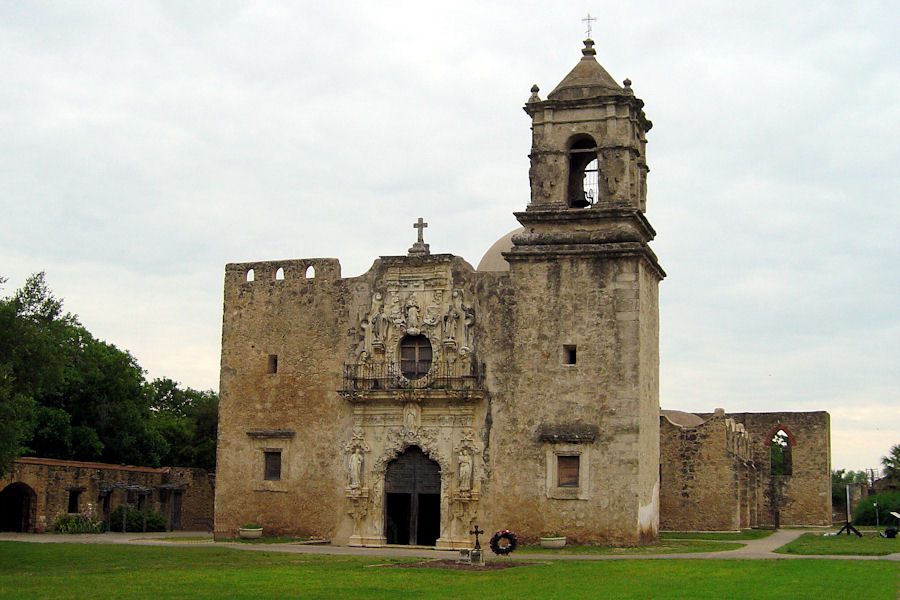
We all left for San Antonio at around 7:30 am. We drove for about two hours and finally made it to San Antonio. Our first stop we made was at a mission called San Jose. It was a big mission with the most notable thing there was the church. Around the walls were Indian Quarters. The inside of the church was magnificent and is still being used today. It was completely unexpected! After we finished with our first stop, we stopped at an nearby Whataburger. We freshened and head towards our next stop. We stopped by another mission, but I did not catch the name (I could not even find it online). This one only had the church which, again, is still running today. We saw what we needed to see and then drove to the next location. The next place we visited was the Alamo. We first got our picture in front of the Alamo and then went inside. It looked like a redone museum. The most interesting part was learning about the types of guns that they had on display. We made a quick stop at the gift shop and left with satisfaction. We all decided to make one more stop before we left. Our last stop was at the Tower of the Americas. It was a massive! The outside ground area looked like a meditation garden. We bought our tickets and went up the elevator. The view was priceless and was indeed terrifying! We spent a good hour at the Tower and then headed home. We got home at around 7:00 pm. My favorite thing to see was probably the San Jose mission. It had amazing architecture from different people all around the world. In conclusion, we all had fun and lived through history!
Tuesday, January 13, 2015

Subscribe to:
Posts (Atom)